Treat each acoustic door as an operating assembly: leaf, frame, seals, threshold, hardware and adjoining construction. Product documentation can establish what was supplied. Field verification addresses the condition in which that product was installed and operated.
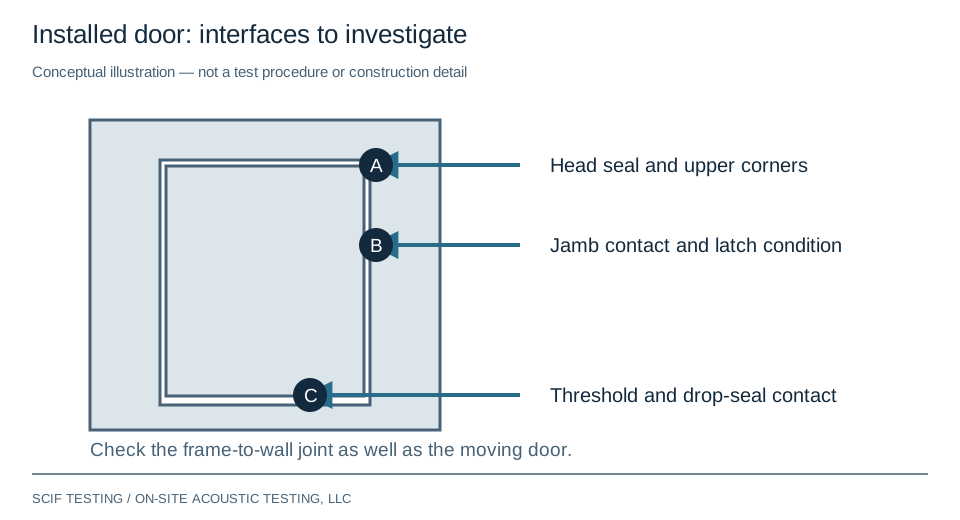
Prepare an operating-condition record
- Confirm the door is complete, adjusted and able to latch as intended.
- Record which leaf or leaves are tested and how inactive leaves are secured.
- Identify the threshold, drop-seal and perimeter-seal configuration.
- Keep adjacent construction and frame joints in the inspection scope.
- Arrange access and controls so the door remains in the agreed condition.
Separate screening from acceptance
A screening observation can help locate a suspected gap, but it does not replace the specified acoustic measurement. Taping a joint, pressing a seal or changing a latch during investigation creates a changed test condition. Record the change, its purpose and whether it was removed before final verification.
Make the retest actionable
Use one identifier for each door throughout inspection, repair and retesting. A useful record includes the as-found state, repair description, date, test condition and final disposition. If a threshold correction changes door operation, the security and accessibility implications must be reviewed by the responsible project team.
For a large door program, sequence representative early checks while installers are available, then complete the agreed coverage. Do not infer that every door passes because a sample passes. The final report should distinguish tested doors, untested doors and items awaiting corrective work.
Use a door disposition record
A door register should show what the team knows at each stage, including items that remain untested. The following fields make the record useful to installers, the measurement team and the person responsible for closure. Keep real opening identifiers and location details in the project’s approved records.
| Record element | What to establish |
|---|---|
| Item and scope | Opening identifier, selected test boundary, required method and criterion. |
| As-found condition | Closure and latching state, seal arrangement, adjoining construction, and any access limitation. |
| Diagnostic change | What was temporarily altered, the observation it addressed, and whether the treatment was removed. |
| Permanent correction | Approved work reference, responsible party, completion date, and operational review where required. |
| Verification and disposition | Retest reference, final installed condition, applicable result, outstanding limitations and authority disposition. |
For example, a temporary treatment that changes a screening observation can help prioritize investigation. The record must still distinguish that observation from a subsequent measurement after an approved permanent correction. This is an illustrative workflow, not a published project result.
See also acoustic leakage and transmission paths and acoustic remediation and retesting for investigation and closeout considerations.
For an initial scope discussion, request testing using unclassified information only. OSAT documents measured performance; the responsible authority makes acceptance and accreditation decisions.