An RF shielding test needs a project-specific performance schedule. The schedule should identify frequency, required attenuation, field regime, polarization where applicable, test locations and the agreed method. There is no single attenuation limit that should be applied to every SCIF or SAPF.
Create a frequency-and-location matrix
| Scope element | Decision required |
|---|---|
| Frequency and regime | What range and field conditions are relevant to the approved requirement? |
| Performance limit | What shielding effectiveness is required at each specified condition? |
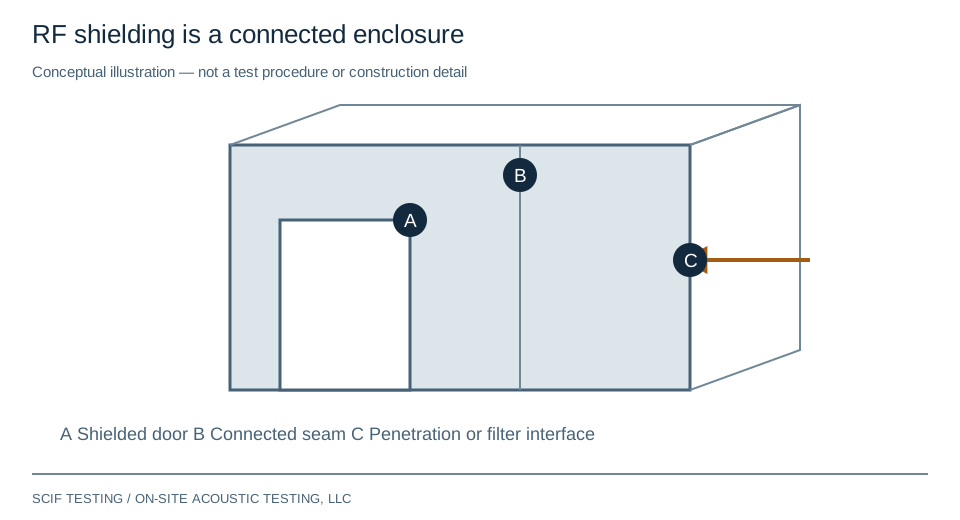
| Locations | Which doors, seams, penetrations and enclosure surfaces are covered? |
| Measurement capability | Can the proposed system demonstrate the requirement above its practical noise and leakage limits? |
Make limitations explicit
Instrument specifications alone do not establish usable on-site measurement range. Ambient signals, receiver noise, reference level, cable coupling and the test arrangement affect the result. A signal below the measurement floor may support a qualified lower bound, but not an arbitrary exact attenuation value.
Keep the conclusion within the measured scope
The report should state the method and edition, enclosure condition, reference measurements, test geometry, locations, frequencies and acceptance comparison. A low-resistance continuity check is useful construction evidence but is not a substitute for RF attenuation measurements. Routine shielding measurements also do not constitute TEMPEST certification.
For projects requesting IEEE 299, review method applicability and edition status before freezing the test plan.
Plan each part of the RF verification
- Pre-mobilization checklist — Agree criteria, frequencies, access and reporting before travel.
- Doors, seams and penetrations — Keep an interface register tied to the enclosure boundary.
- Materials and construction — Review substitutions and installed interfaces beyond a material rating.
- Construction hold points — Inspect and test while interfaces remain accessible.
- Leakage investigation — Separate enclosure findings from measurement limitations.
- Repair and retest coverage — Define what must be measured again after corrective work.
- Periodic verification of existing SCIFs — Consider whether changes since commissioning warrant renewed acoustic or RF measurements.
For Special Access Program Facilities, see SAPF testing and authority-specific RF requirements.
For an initial scope discussion, request testing using unclassified information only. OSAT documents measured performance; the responsible authority makes acceptance and accreditation decisions.