A visible gap may explain a poor result, but visibility does not establish dominance. Sound can also cross a partition through its surface or travel around it through connected floors, ceilings, structure and services. Several paths may contribute at the same time.
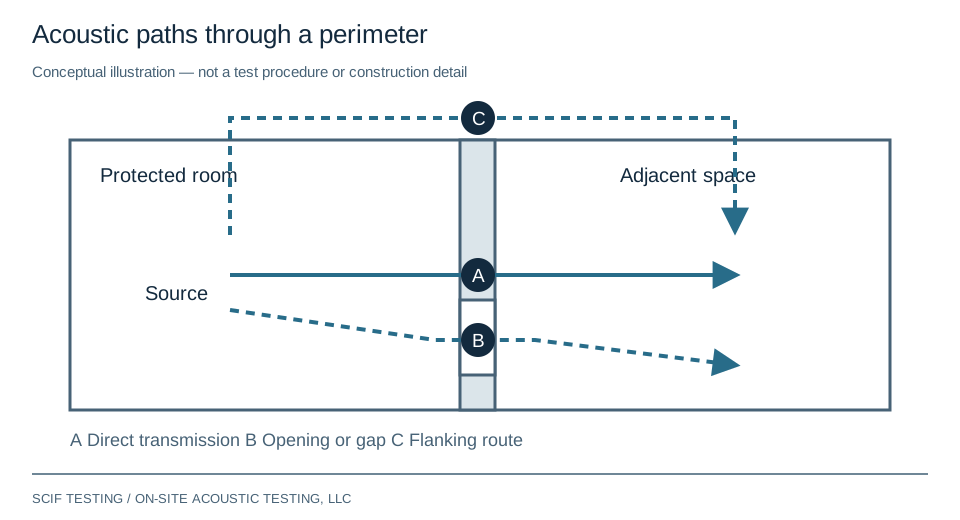
Use a path hypothesis register
| Hypothesis | Evidence to seek |
|---|---|
| Door or frame leakage | Reproducible observations around seals, hardware and adjoining joints |
| Penetration or service route | A continuous path through the boundary and its installed treatment |
| Flanking transmission | Connected construction linking the source and receiving areas |
| Primary partition performance | Results consistent with the complete assembly and field conditions |
Change one condition at a time
Comparative investigation is easier to interpret when the source, receiving conditions and other relevant variables remain controlled. Document any temporary treatment and repeat the observation where appropriate. A change in a single overall level can conceal different frequency behavior; retain the relevant spectral evidence rather than relying only on one headline number.
Know what a negative finding means
Not finding a defect at one interface does not establish that the interface is sound under all conditions. Likewise, a listening observation cannot establish the entire partition’s installed rating. State the investigation’s coverage and limitations, then agree whether a broader measurement or inspection is needed.
The output should be a prioritized account of evidence, uncertainty and next steps. Construction repairs remain subject to approved design details; investigation findings are not blanket authorization to modify a secure boundary.
Secure doors are one common interface; the secure-door testing guide explains how observations can be documented and followed by verification after corrective work.
For an initial scope discussion, request testing using unclassified information only. OSAT documents measured performance; the responsible authority makes acceptance and accreditation decisions.