An enclosure is interrupted wherever people, power, air, signals or services cross its boundary. Doors, removable panels, joints and penetrations therefore need explicit coverage in the verification plan. A material coupon or product rating does not establish the performance of every installed interface.
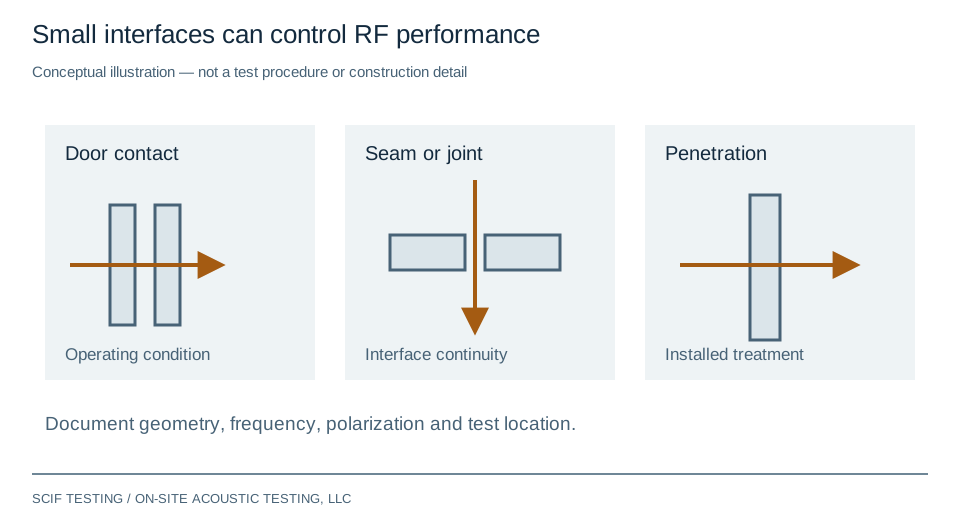
Identify the interface and its operating state
- Record the door or access panel condition, including closure and latching.
- Identify demountable seams and transitions between shielding systems.
- List installed penetrations and the treatment specified for each.
- Confirm that filters and service connections are complete for the test stage.
- Identify concealed interfaces that need inspection or an earlier hold point.
Separate construction checks from performance evidence
Visual inspection and electrical continuity checks can identify workmanship questions. They do not prove the frequency-dependent attenuation of a completed enclosure. Similarly, a favorable RF result at one location does not automatically validate every apparently similar joint. Report the actual coverage.
Record changes that require reconsideration
New cables, replacement filters, door servicing and additional penetrations can change the boundary after initial testing. Keep the enclosure interface register with the facility’s controlled maintenance records and let the responsible authority determine the verification needed after a change.
Use the RF retest change register to connect corrective work with its final measured disposition. Do not publish sensitive interface locations through the website.
Keep an interface change register
Use a controlled register to connect each enclosure interface to its construction state and the evidence required at that stage. A register is particularly useful when several trades work on the same boundary or services change after initial verification.
| Record element | What to establish |
|---|---|
| Interface identity | Use the approved project identifier and refer to controlled drawings; omit protected location details from public correspondence. |
| Required state | Record the specified configuration, applicable performance schedule and whether the item is temporary or final. |
| Inspection evidence | Record accessible workmanship observations separately from continuity or RF measurement results. |
| Change and authorization | Identify the changed service, joint, panel or door work, its approval reference and affected adjacent construction. |
| Verification decision | Record who determines the necessary test coverage, the evidence obtained and any remaining exception. |
A visually similar replacement is still a change to review. Avoid closing the register solely because a continuity reading is favorable or a product certificate is available. The approved verification plan determines the evidence needed for the installed interface.
For an initial scope discussion, request testing using unclassified information only. OSAT documents measured performance; the responsible authority makes acceptance and accreditation decisions.